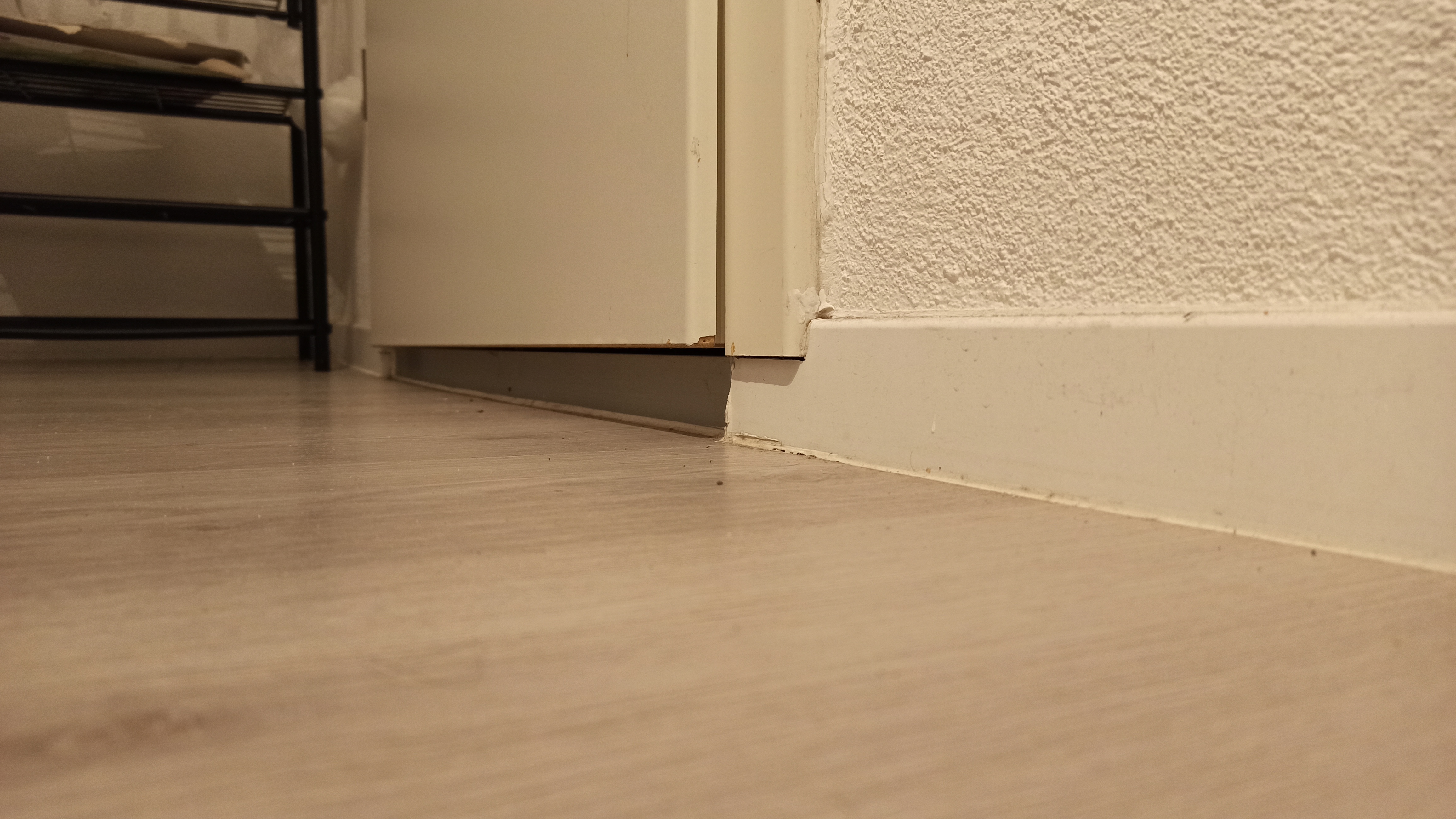
 The humidity hit 88 percent by noon yesterday on Hallandale Beach Boulevard, the kind of thick air that sticks to your arms the moment you step outside. Inside a ranch house three blocks west of the Intracoastal, the AC had been running since 7 a.m. but the back bedroom still felt like a sauna. The homeowner noticed the door to that room slammed shut every time the blower kicked on — hard enough to rattle the frame. She'd stuffed a towel under the gap to keep the cool air in, thinking she was helping. Instead, she'd cut off the return path. The room pressurized like a balloon, the supply vent kept pushing, and the door became a pressure-relief valve. That slam wasn't a ghost. It was physics asking for its airway back.
How big should the gap under my door be?
Most residential doors need a 1/2-inch to 3/4-inch gap at the bottom. That's the thickness of two to three quarters stacked flat. If you have carpet and pad, measure from the top of the carpet — not the subfloor. A tighter gap chokes the return path. A wider gap wastes conditioned air into hallways. The sweet spot lets enough air move back to the central return without turning your hallway into a supply duct. Think of your duct system like a loop of garden hose. The supply side pushes water out. The return side sucks it back. If you kink the return end — by sealing a door tight — pressure builds at the supply end. The blower motor pulls more amps, the coil gets colder than it should, and you risk freezing the evaporator. That 1/2-inch gap is the un-kink.What happens when there's no gap under the door?
Room pressure goes positive. The supply vent keeps delivering 100–150 CFM (cubic feet per minute) of cooled air, but none of it can escape back to the return. The door becomes the only relief path. When the blower ramps up, the pressure difference slams the door shut. When the cycle ends, the door swings open. You hear it. You feel it. The room stays warmer because the supply air can't mix — it's fighting its own back-pressure. The blower motor draws higher current. Over weeks, that extra load shortens motor life. The evaporator coil runs colder, pulling more moisture out of the air than designed. That sounds good in July, but it can freeze the coil solid, shutting down cooling entirely. We've seen it happen on Southwest 10th Street homes where every bedroom door got weather-stripped tight for "energy savings." The fix was a 20-minute door undercut. The bill was a lot less than a burned-out blower motor.Why does my bedroom door slam when the AC kicks on?
That slam is the pressure difference equalizing violently. When the blower starts, the supply duct pressurizes instantly. The room has no return path. The door — light, on hinges — becomes the weakest seal. Air rushes under it at high velocity, creating a low-pressure zone that yanks the door shut. It's the same principle that slams a screen door when you open the front door on a breezy day. If you hold a piece of lightweight tissue near the gap while the system runs, you'll see it flap toward the hallway. That's return air trying to get home. The slam stops the moment you crack the door an inch. Proof the gap matters.Can I just cut the door bottom instead of leaving a gap?
Yes — that's called undercutting. A hand saw or circular saw with a fine-tooth blade takes 15 minutes per door. Cut 3/4 inch off the bottom, reinstall, and you've got your return path. Hollow-core doors have about 1 inch of solid wood at the bottom. Solid-core doors give you more room. Measure twice. Cut once. Sand the edge so it doesn't snag carpet. If you'd rather not cut, a door grille (a slotted vent installed in the lower third of the door) works too. It lets air pass while keeping the door closed. We see these in older Hallandale condos where the HOA forbids visible gaps. They cost a few dollars at any hardware store and install with four screws.How do I check if my returns are working right?
Do the tissue test. With the AC running, hold a single ply of facial tissue at the bottom of each bedroom door. It should pull gently toward the hallway — not flap wildly, not fall straight down. A gentle pull means air is moving back to the return at the right speed. No movement means the gap is too small or blocked. Wild flapping means the gap is too big or the return is undersized. Check every room with a supply vent and a closable door. Bathrooms with exhaust fans need their own calculation — the fan pulls air out, so the door gap must supply replacement air or the fan starves. That's a different conversation. For bedrooms, the tissue test tells you what you need to know in 30 seconds.Here's the same pressure problem from the builder's side: a home-building educator walks through why bedrooms with no return-air path pressurize, run hot or cold, and fight the system — and shows a proper fix with jumper ducts.
Matt Risinger of Risinger Homes, an independent high-performance home builder in Austin, Texas, explains in this video-blog segment why most homes have poor return-air pathways out of the bedrooms — and why those bedrooms end up noticeably warmer or cooler than the rest of the house. He walks through how jumper ducts work: a ducted path, usually above the door, that lets air flow back to the central return when the bedroom door is closed, keeping room pressure balanced and the system breathing the way it was designed. He frames it as part of getting a house's comfort and efficiency right, showing the correct approach rather than the shortcuts he sees in the field. It's the exact pressure problem the tissue test above checks for — solved with a dedicated duct instead of a gap under the door — and it makes a strong case for checking every closed room in your own home.
When to call us
DIY is great, but some jobs need a pro. If the problem persists, you spot anything dangerous, or you'd rather have an expert handle it, call (754) 432-8931 — Hallandale Air Duct Care serves Hallandale Beach and Broward (Mon-Sat 8AM-8PM). No pressure, no upsells.